Introduction
Your pod is stuck. The deployment rolled out successfully, but containers refuse to start. You run kubectl get pods and see that dreaded CreateContainerConfigError status.
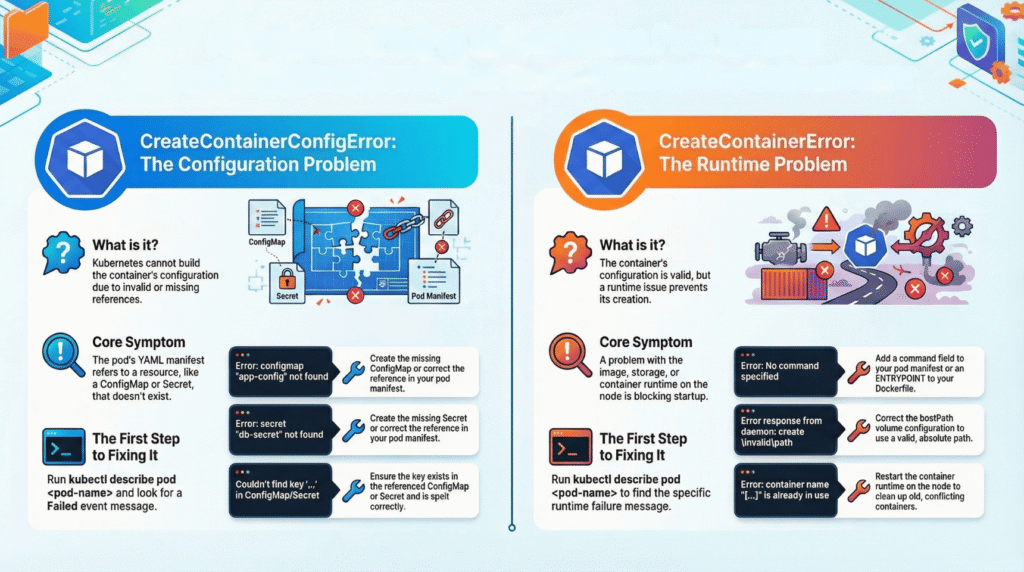
CreateContainerConfigError occurs when Kubernetes cannot build the container configuration before launching the process. This happens during the pre-start phase—the container runtime never executes your application code. Your app logs? Empty. The issue lies in how Kubernetes assembles configuration data from ConfigMaps, Secrets, or volume mounts.
Key Distinction: This isn’t a runtime crash. The container never started, so traditional debugging (checking logs, exec into pod) won’t work.
Error Flow Visualization
graph TD
    A[Pod Creation Request] --> B{Configuration Valid?}
    B -->|No| C[CreateContainerConfigError]
    B -->|Yes| D[Container Runtime]
    D --> E{Runtime Success?}
    E -->|No| F[CreateContainerError]
    E -->|Yes| G[Running Pod]

    C --> H[Check ConfigMaps]
    C --> I[Check Secrets]
    C --> J[Check Volume Mounts]
C --> K[Check RBAC]Common Causes
1. Missing ConfigMap Reference
# deployment.yaml
apiVersion: apps/v1
kind: Deployment
metadata:
  name: web-app
spec:
  replicas: 1
  selector:
    matchLabels:
      app: web
  template:
    metadata:
      labels:
        app: web
    spec:
      containers:
      - name: nginx
        image: nginx:1.21
        envFrom:
        - configMapRef:
            name: app-config  # ❌ This ConfigMap doesn't exist
Error Output:
kubectl describe pod web-app-xyz
Events:
  Warning  Failed  CreateContainerConfigError
  configmap "app-config" not found
2. Secret Key Mismatch
# pod-with-secret.yaml
apiVersion: v1
kind: Pod
metadata:
  name: database-client
spec:
  containers:
  - name: psql
    image: postgres:14
    env:
    - name: DB_PASSWORD
      valueFrom:
        secretKeyRef:
          name: db-credentials
          key: password  # ❌ Actual key is 'db-password'
Verification Commands:
# Check if Secret exists
kubectl get secret db-credentials -o json | jq '.data | keys'

# Output shows actual keys
[
  "db-password",
  "username"
]
3. Volume Mount Configuration Issue
# deployment-with-volume.yaml
apiVersion: apps/v1
kind: Deployment
metadata:
  name: config-reader
spec:
  template:
    spec:
      containers:
      - name: app
        image: busybox
        command: ['sh', '-c', 'cat /config/settings.json']
        volumeMounts:
        - name: config-volume
          mountPath: /config
          subPath: app-settings.json  # ❌ subPath doesn't exist in ConfigMap
      volumes:
      - name: config-volume
        configMap:
          name: application-config
Troubleshooting Decision Tree
flowchart TD
    Start[CreateContainerConfigError] --> Describe[kubectl describe pod]
    Describe --> CheckEvents{Events Show?}

    CheckEvents -->|ConfigMap not found| VerifyCM[kubectl get configmap]
    CheckEvents -->|Secret not found| VerifySecret[kubectl get secret]
    CheckEvents -->|Key reference failed| CheckKeys[Verify key names]
    CheckEvents -->|Mount failed| CheckVolumes[Inspect volumeMounts]

    VerifyCM --> CMExists{Exists?}
    CMExists -->|No| CreateCM[Create ConfigMap]
    CMExists -->|Yes| CheckNamespace[Wrong namespace?]

    VerifySecret --> SecretExists{Exists?}
    SecretExists -->|No| CreateSecret[Create Secret]
    SecretExists -->|Yes| CheckKeyName[Verify key in Secret]

    CheckKeys --> FixManifest[Update pod spec]
    CheckVolumes --> FixVolume[Correct mount path/subPath]

    CreateCM --> Restart[Delete pod or rollout restart]
    CreateSecret --> Restart
    FixManifest --> Restart
    FixVolume --> Restart
    CheckNamespace --> Restart
    CheckKeyName --> Restart
Step-by-Step Resolution
Step 1: Identify the Error
# Check pod status
kubectl get pods -n production

NAME                    READY   STATUS                       RESTARTS   AGE
web-app-7d9c8b-xyz      0/1     CreateContainerConfigError   0          2m
Step 2: Extract Event Details
# Get detailed pod information
kubectl describe pod web-app-7d9c8b-xyz -n production
Critical Section – Events:
Events:
  Type     Reason     Age                From               Message
  ----     ------     ----               ----               -------
  Normal   Scheduled  3m                 default-scheduler  Successfully assigned production/web-app-7d9c8b-xyz to node-1
  Warning  Failed     2m (x5 over 3m)    kubelet            Error: configmap "app-config" not found
Step 3: Audit Configuration Resources
Comprehensive Check Script:
#!/bin/bash
# troubleshoot-pod.sh

POD_NAME=$1
NAMESPACE=${2:-default}

echo "=== Pod Status ==="
kubectl get pod $POD_NAME -n $NAMESPACE

echo -e "\n=== Events ==="
kubectl describe pod $POD_NAME -n $NAMESPACE | grep -A 20 "Events:"

echo -e "\n=== Referenced ConfigMaps ==="
kubectl get pod $POD_NAME -n $NAMESPACE -o json | \
  jq -r '.spec.volumes[]?.configMap.name // empty' | \
  while read cm; do
    echo "Checking ConfigMap: $cm"
    kubectl get configmap $cm -n $NAMESPACE 2>&1
  done

echo -e "\n=== Referenced Secrets ==="
kubectl get pod $POD_NAME -n $NAMESPACE -o json | \
  jq -r '.spec.volumes[]?.secret.secretName // empty' | \
  while read secret; do
    echo "Checking Secret: $secret"
    kubectl get secret $secret -n $NAMESPACE 2>&1
  done

echo -e "\n=== Environment Variables from ConfigMaps ==="
kubectl get pod $POD_NAME -n $NAMESPACE -o json | \
  jq -r '.spec.containers[].envFrom[]?.configMapRef.name // empty'

echo -e "\n=== Environment Variables from Secrets ==="
kubectl get pod $POD_NAME -n $NAMESPACE -o json | \
  jq -r '.spec.containers[].envFrom[]?.secretKeyRef.name // empty'
Usage:
chmod +x troubleshoot-pod.sh
./troubleshoot-pod.sh web-app-7d9c8b-xyz production
Fix Scenarios
Scenario 1: Create Missing ConfigMap
# Quick inline creation
kubectl create configmap app-config \
  --from-literal=API_URL=https://api.example.com \
  --from-literal=LOG_LEVEL=info \
  -n production
Or from file:
# config.properties
API_URL=https://api.example.com
LOG_LEVEL=info
MAX_CONNECTIONS=100

# Create from file
kubectl create configmap app-config \
  --from-file=config.properties \
  -n production
Declarative approach:
# configmap.yaml
apiVersion: v1
kind: ConfigMap
metadata:
  name: app-config
  namespace: production
data:
  API_URL: "https://api.example.com"
  LOG_LEVEL: "info"
  config.json: |
    {
      "database": {
        "host": "db.internal",
        "port": 5432
      },
      "cache": {
        "ttl": 3600
      }
    }
kubectl apply -f configmap.yaml
Scenario 2: Fix Secret Key Reference
Current broken configuration:
env:
- name: DB_PASSWORD
  valueFrom:
    secretKeyRef:
      name: db-credentials
      key: password  # ❌ Wrong key
Check actual keys:
kubectl get secret db-credentials -o jsonpath='{.data}' | jq 'keys'
# Output: ["db-password", "username"]
Corrected configuration:
env:
- name: DB_PASSWORD
  valueFrom:
    secretKeyRef:
      name: db-credentials
      key: db-password  # ✅ Correct key
Apply fix:
kubectl patch deployment web-app -n production --type='json' \
  -p='[{"op": "replace", "path": "/spec/template/spec/containers/0/env/0/valueFrom/secretKeyRef/key", "value":"db-password"}]'
Scenario 3: Volume Mount SubPath Issue
Problematic manifest:
volumeMounts:
- name: config-volume
  mountPath: /app/config
  subPath: application.conf  # ❌ File doesn't exist in ConfigMap

volumes:
- name: config-volume
  configMap:
    name: app-settings
Check ConfigMap contents:
kubectl get configmap app-settings -o json | jq '.data | keys'
# Output: ["app.conf", "database.conf"]
Fix options:
Option A – Remove subPath:
volumeMounts:
- name: config-volume
  mountPath: /app/config
  # Mount entire ConfigMap
Option B – Use correct filename:
volumeMounts:
- name: config-volume
  mountPath: /app/config/application.conf
  subPath: app.conf  # ✅ Matches actual key
Scenario 4: RBAC Permission Issues
Error message:
Error: secrets "api-keys" is forbidden:
User "system:serviceaccount:production:default" cannot get resource "secrets"
Grant access:
# rbac-fix.yaml
apiVersion: v1
kind: ServiceAccount
metadata:
  name: app-service-account
  namespace: production
---
apiVersion: rbac.authorization.k8s.io/v1
kind: Role
metadata:
  name: secret-reader
  namespace: production
rules:
- apiGroups: [""]
  resources: ["secrets", "configmaps"]
  verbs: ["get", "list"]
---
apiVersion: rbac.authorization.k8s.io/v1
kind: RoleBinding
metadata:
  name: read-secrets
  namespace: production
subjects:
- kind: ServiceAccount
  name: app-service-account
  namespace: production
roleRef:
  kind: Role
  name: secret-reader
  apiGroup: rbac.authorization.k8s.io
Update Deployment to use ServiceAccount:
spec:
  template:
    spec:
      serviceAccountName: app-service-account
      containers:
      - name: app
        image: myapp:1.0
kubectl apply -f rbac-fix.yaml
kubectl rollout restart deployment web-app -n production
Error Comparison Matrix
graph LR
    A[Pod Start Process] --> B{Config Assembly}
    B -->|Failed| C[CreateContainerConfigError]
    B -->|Success| D{Runtime Creation}
    D -->|Failed| E[CreateContainerError]
    D -->|Success| F{App Execution}
    F -->|Failed| G[CrashLoopBackOff]

    style C fill:#ff6b6b
    style E fill:#ffa94d
    style G fill:#ffd43b
style F fill:#51cf66| Error Type | Phase | Container Started? | Check Logs? | Common Causes |
|---|---|---|---|---|
| CreateContainerConfigError | Pre-start | ❌ No | ❌ Useless | Missing ConfigMap/Secret, key mismatch, volume mount error |
| CreateContainerError | Runtime init | ❌ No | ❌ Empty | Invalid command, image pull failure, resource limits |
| CrashLoopBackOff | Post-start | ✅ Yes | ✅ Check | Application crash, missing dependencies, port conflicts |
Automated Detection Script
#!/bin/bash
# detect-config-errors.sh

NAMESPACE=${1:-default}

echo "Scanning for CreateContainerConfigError in namespace: $NAMESPACE"
echo "================================================================"

kubectl get pods -n $NAMESPACE --field-selector=status.phase!=Running,status.phase!=Succeeded -o json | \
jq -r '.items[] |
  select(.status.containerStatuses != null) |
  select(.status.containerStatuses[].state.waiting.reason == "CreateContainerConfigError") |
  {
    pod: .metadata.name,
    namespace: .metadata.namespace,
    containers: [.status.containerStatuses[].name],
    message: .status.containerStatuses[].state.waiting.message
  }' | \
jq -s '.' | \
jq -r '.[] | "Pod: \(.pod)\nContainers: \(.containers | join(", "))\nError: \(.message)\n---"'

echo ""
echo "Detailed Troubleshooting:"
echo "========================="

kubectl get pods -n $NAMESPACE --field-selector=status.phase!=Running -o name | \
while read pod; do
  POD_NAME=$(echo $pod | cut -d'/' -f2)
  ERROR_STATUS=$(kubectl get $pod -n $NAMESPACE -o jsonpath='{.status.containerStatuses[*].state.waiting.reason}')

  if [[ $ERROR_STATUS == *"CreateContainerConfigError"* ]]; then
    echo ""
    echo "🔍 Analyzing: $POD_NAME"
    echo "Events:"
    kubectl describe pod $POD_NAME -n $NAMESPACE | grep -A 10 "Events:" | grep -E "(ConfigMap|Secret|not found|forbidden)"
  fi
done
Prevention Strategies
1. Pre-Deployment Validation
#!/bin/bash
# validate-resources.sh

MANIFEST=$1
NAMESPACE=${2:-default}

echo "Validating manifest: $MANIFEST"

# Extract ConfigMap references
CONFIGMAPS=$(yq eval '.spec.template.spec.volumes[].configMap.name // empty' $MANIFEST 2>/dev/null)

for cm in $CONFIGMAPS; do
  if kubectl get configmap $cm -n $NAMESPACE &>/dev/null; then
    echo "✅ ConfigMap $cm exists"
  else
    echo "❌ ConfigMap $cm NOT FOUND"
    exit 1
  fi
done

# Extract Secret references
SECRETS=$(yq eval '.spec.template.spec.volumes[].secret.secretName // empty' $MANIFEST 2>/dev/null)

for secret in $SECRETS; do
  if kubectl get secret $secret -n $NAMESPACE &>/dev/null; then
    echo "✅ Secret $secret exists"
  else
    echo "❌ Secret $secret NOT FOUND"
    exit 1
  fi
done

echo "✅ All resources validated"
Usage in CI/CD:
./validate-resources.sh deployment.yaml production && \
kubectl apply -f deployment.yaml
2. Helm Chart Dependencies
# Chart.yaml
apiVersion: v2
name: web-application
version: 1.0.0
dependencies:
  - name: common-config
    version: "1.x.x"
    repository: "@company-repo"
# values.yaml
configMaps:
  create: true
  data:
    API_URL: "https://api.example.com"
    LOG_LEVEL: "info"

secrets:
  create: true
  data:
    DB_PASSWORD: "{{ .Values.database.password }}"
# templates/deployment.yaml
apiVersion: apps/v1
kind: Deployment
metadata:
  name: {{ .Release.Name }}
spec:
  template:
    spec:
      containers:
      - name: app
        image: {{ .Values.image.repository }}:{{ .Values.image.tag }}
        envFrom:
        - configMapRef:
            name: {{ .Release.Name }}-config
        {{- if .Values.secrets.create }}
        - secretRef:
            name: {{ .Release.Name }}-secrets
        {{- end }}
3. Kustomize Overlay Strategy
├── base/
│   ├── deployment.yaml
│   ├── configmap.yaml
│   ├── secret.yaml
│   └── kustomization.yaml
└── overlays/
    ├── dev/
    │   ├── configmap.yaml
    │   └── kustomization.yaml
    └── prod/
        ├── configmap.yaml
        └── kustomization.yaml
base/kustomization.yaml:
apiVersion: kustomize.config.k8s.io/v1beta1
kind: Kustomization

resources:
- deployment.yaml
- configmap.yaml
- secret.yaml

configMapGenerator:
- name: app-config
  literals:
  - APP_ENV=base
overlays/prod/kustomization.yaml:
apiVersion: kustomize.config.k8s.io/v1beta1
kind: Kustomization

bases:
- ../../base

configMapGenerator:
- name: app-config
  behavior: merge
  literals:
  - APP_ENV=production
  - API_URL=https://api.prod.example.com
# Deploy with guaranteed resource creation
kustomize build overlays/prod | kubectl apply -f -
4. Admission Controller Validation
# validating-webhook.yaml
apiVersion: admissionregistration.k8s.io/v1
kind: ValidatingWebhookConfiguration
metadata:
  name: config-validator
webhooks:
- name: validate-config-refs.example.com
  admissionReviewVersions: ["v1"]
  clientConfig:
    service:
      name: validation-service
      namespace: kube-system
      path: "/validate"
  rules:
  - operations: ["CREATE", "UPDATE"]
    apiGroups: ["apps"]
    apiVersions: ["v1"]
    resources: ["deployments", "statefulsets"]
  failurePolicy: Fail
  sideEffects: None
Validation logic (Go example):
// webhook-validator.go
func validateConfigReferences(pod *corev1.Pod) error {
    client := kubernetes.NewForConfigOrDie(config)

    for _, volume := range pod.Spec.Volumes {
        if volume.ConfigMap != nil {
            _, err := client.CoreV1().ConfigMaps(pod.Namespace).
                Get(context.TODO(), volume.ConfigMap.Name, metav1.GetOptions{})
            if err != nil {
                return fmt.Errorf("ConfigMap %s not found", volume.ConfigMap.Name)
            }
        }

        if volume.Secret != nil {
            _, err := client.CoreV1().Secrets(pod.Namespace).
                Get(context.TODO(), volume.Secret.SecretName, metav1.GetOptions{})
            if err != nil {
                return fmt.Errorf("Secret %s not found", volume.Secret.SecretName)
            }
        }
    }
    return nil
}
Quick Reference Commands
# Diagnose
kubectl get pods | grep CreateContainerConfigError
kubectl describe pod <pod-name> | grep -A 20 Events

# Verify resources
kubectl get configmap <name> -o yaml
kubectl get secret <name> -o jsonpath='{.data}' | jq 'keys'

# Check keys in ConfigMap
kubectl get configmap <name> -o json | jq '.data | keys'

# Check keys in Secret (base64 decoded)
kubectl get secret <name> -o json | jq -r '.data | to_entries[] | .key'

# Force pod recreation
kubectl delete pod <pod-name>
kubectl rollout restart deployment <deployment-name>

# Watch pod recovery
kubectl get pods -w

# Export pod spec for analysis
kubectl get pod <pod-name> -o yaml > debug-pod.yaml
Advanced Debugging Technique
#!/bin/bash
# deep-inspect.sh

POD=$1
NAMESPACE=${2:-default}

echo "=== Container Configuration Assembly ==="
kubectl get pod $POD -n $NAMESPACE -o json | jq '{
  configMaps: [
    .spec.volumes[]? | select(.configMap != null) |
    {
      name: .configMap.name,
      mountedAs: .name,
      optional: .configMap.optional
    }
  ],
  secrets: [
    .spec.volumes[]? | select(.secret != null) |
    {
      name: .secret.secretName,
      mountedAs: .name,
      optional: .secret.optional
    }
  ],
  envFromConfigMaps: [
    .spec.containers[].envFrom[]? | select(.configMapRef != null) |
    .configMapRef.name
  ],
  envFromSecrets: [
    .spec.containers[].envFrom[]? | select(.secretRef != null) |
    .secretRef.name
  ],
  envConfigMapKeys: [
    .spec.containers[].env[]? | select(.valueFrom.configMapKeyRef != null) |
    {
      envVar: .name,
      configMap: .valueFrom.configMapKeyRef.name,
      key: .valueFrom.configMapKeyRef.key
    }
  ],
  envSecretKeys: [
    .spec.containers[].env[]? | select(.valueFrom.secretKeyRef != null) |
    {
      envVar: .name,
      secret: .valueFrom.secretKeyRef.name,
      key: .valueFrom.secretKeyRef.key
    }
  ]
}'

echo ""
echo "=== Cross-Reference Check ==="

# Check each referenced ConfigMap
kubectl get pod $POD -n $NAMESPACE -o json | \
  jq -r '.spec.volumes[]?.configMap.name // empty' | sort -u | \
  while read cm; do
    if kubectl get configmap $cm -n $NAMESPACE &>/dev/null; then
      echo "✅ ConfigMap: $cm"
    else
      echo "❌ ConfigMap: $cm (NOT FOUND)"
    fi
  done

# Check each referenced Secret
kubectl get pod $POD -n $NAMESPACE -o json | \
  jq -r '.spec.volumes[]?.secret.secretName // empty' | sort -u | \
  while read secret; do
    if kubectl get secret $secret -n $NAMESPACE &>/dev/null; then
      echo "✅ Secret: $secret"
    else
      echo "❌ Secret: $secret (NOT FOUND)"
    fi
  done
Conclusion
CreateContainerConfigError is a pre-start configuration assembly failure, not an application bug. The container never executed, making traditional debugging methods ineffective.
Resolution checklist:
- ✅ Run
kubectl describe pod <name>– never start with logs - ✅ Verify ConfigMaps/Secrets exist:
kubectl get configmap/secret - ✅ Check key names match exactly
- ✅ Validate RBAC permissions for ServiceAccount
- ✅ Recreate pod after fixing:
kubectl delete podorkubectl rollout restart
Prevention:
- Validate manifests before deployment (
--dry-run=client) - Use Helm/Kustomize to manage dependencies
- Implement admission controllers for automated validation
- Create CI/CD checks for resource references
When this error appears, check describe output immediately—the Events section contains the exact cause. Fix the configuration synchronization issue, recreate the pod, and your containers will start successfully.